

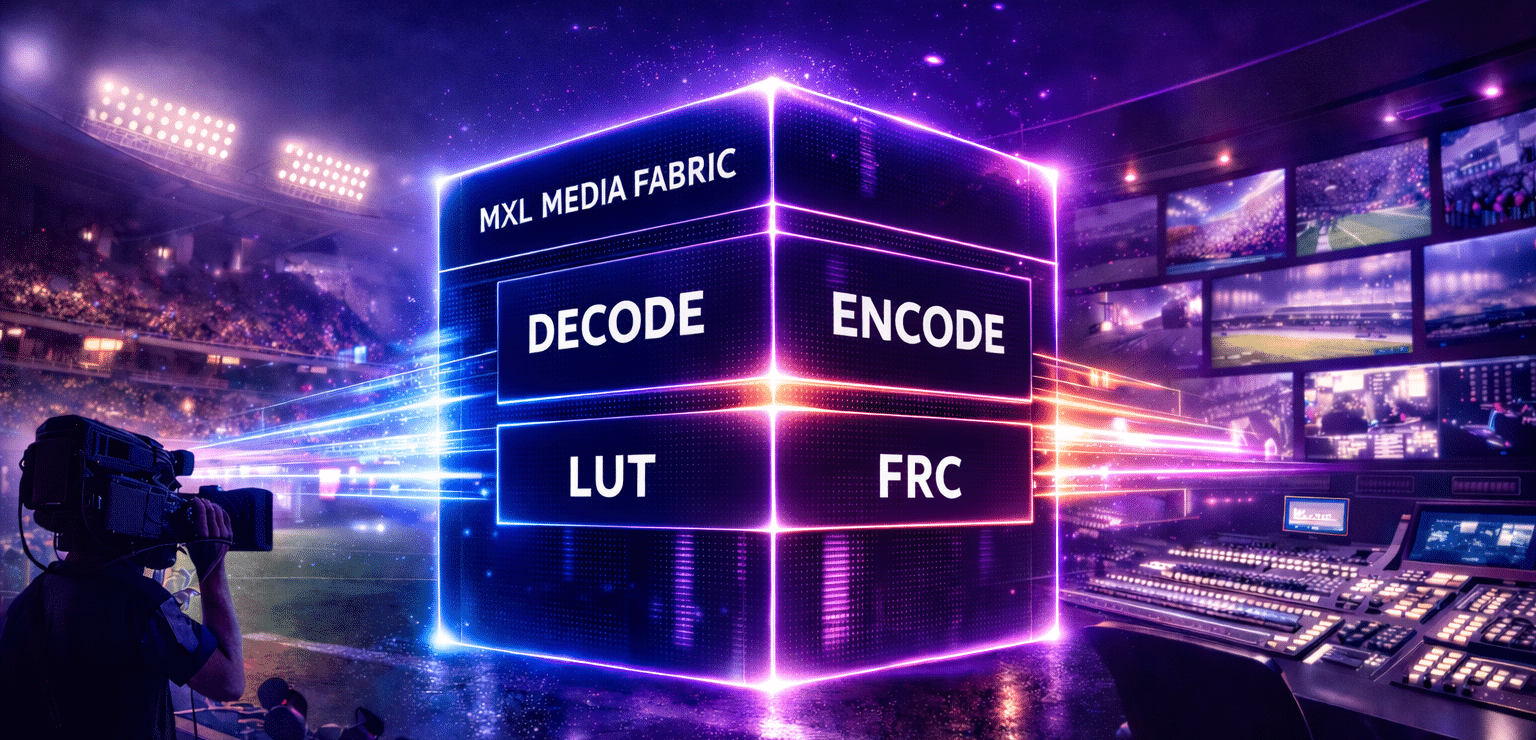
For decades, media workflows have been built around pipelines.
Signals were ingested, processed, and delivered through fixed paths, often dictated by hardware constraints, physical interfaces, and specific formats. Whether SDI or IP-based, the logic remained the same: media flowed through predefined chains, and each transformation step was tightly coupled to a piece of equipment.
This approach has proven highly effective and remains essential across many broadcast workflows. However, as workflows become more complex in functional requirements (spanning contribution, production, processing, and delivery) there is a growing need for more flexibility within processing environments. Reducing unnecessary media transformations, improving resource efficiency, and enabling more dynamic software-based workflows are becoming key challenges.
A different model is now emerging inside processing platforms.
From Pipelines to Media Fabrics

Processing Is No Longer Tied to Hardware
The transition has already started.
Across modern platforms, processing functions are increasingly implemented in software. Encoding and decoding are no longer tied to dedicated appliances. Advanced processing (such as LUT-based HDR conversion, frame-rate conversion, or progressive-to-interlaced transformation) can now be deployed dynamically where needed.
At the same time, workflows are becoming more versatile. A single platform can act as a universal gateway, bridging compressed and baseband domains, interfacing with multiple standards, and adapting to different environments.
Technologies such as JPEG-XS further reinforce this shift, enabling high-quality, low-latency transport and supporting remote production use cases.
Processing is no longer bound to hardware islands, it is becoming fluid, modular, and software-defined.
MXL and SDI: A Useful Analogy
For decades, SDI has been the foundation of professional media workflows.
It provided a simple, reliable, and deterministic way to transport uncompressed video between devices.
In many ways, MXL plays a similar role, but in a fundamentally different environment.
Instead of transporting signals over a cable, MXL enables media to be shared directly in memory between software processing functions. The objective is comparable: low latency, deterministic behaviour, and simplicity of connection.
Where SDI connects physical devices, MXL connects software components.
Where SDI defines a signal, MXL enables access to media in memory.
SDI moved video between devices. MXL moves video between software functions.
Beyond Signal-Based Representations
Even as the industry transitions to software, many workflows continue to rely on well-established media representations derived from traditional signal formats.
These approaches provide a common and widely adopted foundation, ensuring compatibility across a broad range of systems and environments.
At the same time, software-based processing opens the door to complementary models that can further optimize how media is accessed and processed within modern workflows.
Toward More Flexible Media Processing Models
A complementary approach is emerging.
Rather than structuring workflows strictly around signal representations, media can also be handled as shared data, accessed by multiple processing functions in a more flexible way.
This leads to a more planar model of processing, where functions can operate on the same media without enforcing strictly linear transformations.
Such approaches can improve efficiency, reduce unnecessary transformations, and better align with software-native architectures.
Already There: Memory-Based Processing in Practice
This evolution is not entirely new.
In modern software-based platforms, media is already exchanged directly in memory between processing functions, avoiding unnecessary serialization and transport overhead.
Within Ateme architectures, this is implemented through the TITAN Edge Bridge, where decoding, processing (LUT, frame-rate conversion, P→I), and encoding functions exchange media internally in memory.
This enables more efficient chaining of processing functions, reduces latency, and optimizes compute usage.
Memory-based media exchange is not new, standardizing it is.
From Implementation to Standardization
This is where the Media eXchange Layer comes in.
MXL does not introduce a new concept, it standardizes one.
By defining a common framework for in-memory media exchange, MXL enables interoperability across software components and vendors.
What was once an internal optimization becomes an industry capability.
Rethinking the Role of Transport
This evolution complements existing standards rather than replacing them.
SMPTE ST 2110 remains essential for connecting equipment and supporting production environments.
MXL operates at a different level.
It introduces a data plane within software processing nodes, where media is exchanged in memory.
- ST 2110 connects equipment
- MXL connects processing
Together, they form a coherent architecture spanning infrastructure and software-defined workflows.
What This Enables
This evolution translates into tangible benefits across real-world workflows.
Processing chains can be dynamically composed, allowing decoding, transformation (LUT, frame-rate conversion, P→I), and encoding functions to be combined and adapted on demand.
Workflows become more flexible, supporting distributed processing for remote production and enabling software-based gateways between compressed and baseband environments.
As interoperability progresses, multi-vendor software workflows become increasingly realistic.
Conclusion
The release of the MXL SDK 1.0 represents a major milestone for the industry, establishing a first structured foundation for in-memory media exchange and software-based interoperability.
It provides a robust and practical baseline that enables initial deployments and ecosystem alignment.
As the industry continues to evolve, additional approaches to media representation and processing will further optimize software-based workflows and unlock new levels of flexibility.
Ateme already leverages shared-memory media exchange within its software-based processing architecture, enabling efficient and low-latency media workflows. As a next step, Ateme is already working on aligning these capabilities with MXL interoperability.
This practical experience positions Ateme to help shape the next generation of software-native media workflows, contributing to more efficient, flexible, and high-performance media processing environments.
Explore related insights
About the Author

Solution Marketing Senior Director at Ateme
Julien joined Ateme in 2001, starting in the Hardware Department before moving into Product Management, where he led the launch and evolution of the Kyrion product line.
In 2017, he co-founded the BISS-CA standard with the EBU, reshaping the secure distribution of international live events.
He is currently Solution Marketing Director for Contribution and Distribution, driving partner and customer engagement around the Kyrion and TITAN product lines.