

How TITAN File turns proven media processing into a flexible engine for modern content factories.
For years, the conversation focused on transcoding. Experience has shown that the real operational challenge extends far beyond encoding.
Broadcasters, streaming providers and media organisations now face a broader challenge: building content operations that can handle growing asset volumes, more delivery formats and continually evolving audience expectations.
Transcoding remains essential, but it is no longer the destination. It is one capability inside a much larger workflow that prepares, enriches, packages, localises, protects and distributes content.
The Problem Is Bigger Than Encoding
Modern organisations expect a transcoder to deliver excellent video quality, support current codecs, scale with demand and automate routine processing. Those capabilities remain essential, but they are now expected as standard.
The operational challenge sits around the encode: subtitles and captions, DRM, adaptive bitrate packaging, multiple delivery specifications, player compatibility, metadata, quality control and integration with asset management and publishing systems.
Success therefore depends less on choosing an isolated transcoder and more on selecting a media processing platform that can participate reliably in the full content lifecycle.
The real question is not which transcoder to choose. It is which media processing engine can support today’s business while adapting to tomorrow’s workflows.
From Product to Reusable Media Service
Media architectures are becoming more modular. Rather than relying on a single monolithic platform, organisations increasingly combine specialised services around orchestration, storage, asset management, rights, enrichment, processing and publishing.
In this model, file transcoding becomes a reusable service. It can be invoked whenever an asset needs to be transformed, normalised, packaged or prepared for a destination.
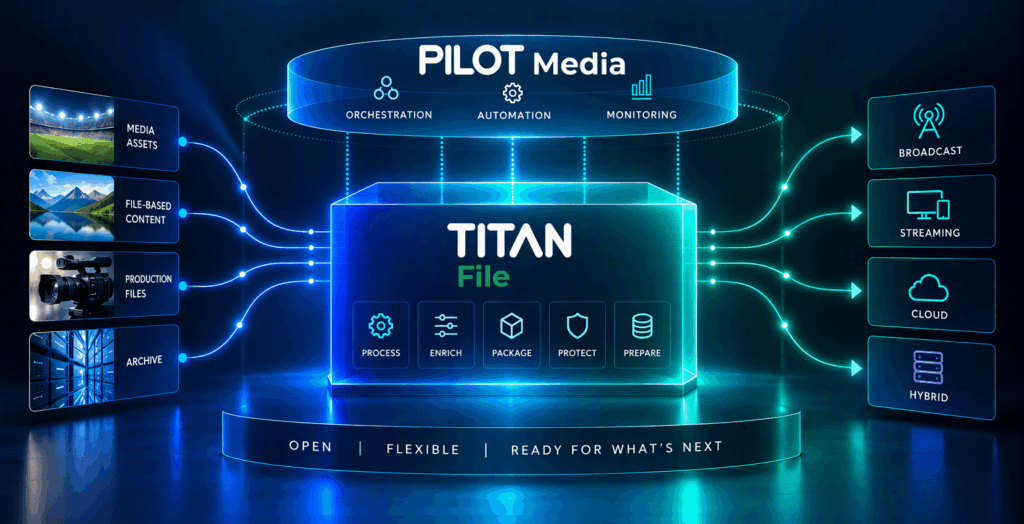
This is where TITAN File fits. It provides the media processing engine within a broader content factory, connecting to the surrounding workflow rather than dictating how that workflow must operate.
Within the Ateme portfolio, TITAN File can also work with PILOT Media, Ateme’s platform for workflow orchestration and media supply-chain automation. PILOT Media coordinates the wider workflow, while TITAN File provides the specialised processing engine that prepares each asset for its destination.
That flexibility supports different deployment choices and operating models. TITAN File can sit within established on-premises environments, cloud-based architectures or hybrid operations, while exposing the processing capabilities needed by upstream orchestration and downstream delivery systems.
Automation That Solves Operational Problems
The goal of automation is not automation for its own sake. It is to shorten turnaround times, reduce repetitive work and help operations teams manage greater content volumes without multiplying manual touchpoints.
A dependable processing engine must therefore do more than accept a job. It must expose clear interfaces, apply consistent processing rules, report status and errors, and fit cleanly into the systems that trigger, monitor and publish each workflow.
TITAN File gives organisations a proven media foundation on which they can automate progressively: starting with repeatable jobs, then extending orchestration across more complex preparation and distribution chains.
Why Media Expertise Still Matters
Greater automation does not remove professional media complexity. It exposes it.
Every asset still has to satisfy the details that determine whether it is truly ready for delivery: packaging constraints, legacy formats, regional specifications, subtitling standards, device behaviours, DRM implementations and customer-specific profiles.
Twenty Years of Development, Embedded in the Product
That expertise is the product of more than two decades of solving real broadcast and streaming requirements, not as isolated features, but as media logic that customers can reuse across workflows.
- Formats and codecs: ingest and output across professional, legacy and emerging standards, including MXF, IMF, MOV, GFX, MPEG transport streams, H.264, HEVC, AV1, VVC, ProRes, JPEG 2000 and more.
- Subtitles, captions and audio: support for broadcast and OTT standards, conversion between formats, multi-track audio, loudness management and premium formats including Dolby technologies.
- HDR and image processing: workflows spanning SDR, HDR10, HLG, HDR10+ and Dolby Vision, alongside scaling, cropping, deinterlacing, frame-rate conversion, logo insertion and thumbnail generation.
- Packaging and protection: HLS, DASH, CMAF and professional file outputs, with DRM, key exchange, watermarking and ad-signalling integrations.
- Interoperability details: configurable manifests, language codes, metadata, caption identifiers, timescales and player-specific signalling—the small requirements that often decide whether a workflow works first time.
- Integration and scale: REST APIs, watchfolders, object storage and deployment across on-premises, cloud and hybrid environments, with processing resources that scale with demand.
The value is not simply the length of the feature list. It is the accumulated knowledge behind it: fewer custom workarounds, faster integration and greater confidence that an asset will reach its destination exactly as required.
The strongest content factories combine flexible orchestration with processing technology that already embeds this specialised knowledge. Years of deployment experience translate into less custom engineering, fewer exceptions to manage and greater confidence that each output will meet its destination requirements.
That combination matters operationally. Teams can spend less time rebuilding media logic around every workflow and more time improving the services and experiences they deliver.
Open by Design
One of the most important shifts in media technology is the move towards openness: openness to integrate, automate and adapt as architectures, partners and business models evolve.
Customers do not want infrastructure that narrows their future choices. They want investments that remain useful across on-premises, cloud and hybrid environments, and that can work with the orchestration and business systems they choose.
Exposing media processing as a flexible, reusable capability makes TITAN File part of an ecosystem rather than an island. It allows organisations to evolve individual parts of the content factory without replacing the processing foundation underneath it.
A Light Path Towards More Intelligent Workflows
AI adds another promising dimension to this evolution. Its near-term value is in adjacent workflow tasks such as enriching metadata, assisting content analysis and helping orchestration systems make better decisions.
Looking ahead, AI agents will increasingly initiate and coordinate media services more dynamically. Emerging approaches such as Model Context Protocol (MCP) offer a structured way for AI systems to interact with enterprise tools, creating a compelling direction for future workflow innovation beyond the capabilities supported by TITAN File today.
The important point is that intelligent automation needs a dependable execution layer. AI may help decide what should happen; TITAN File remains focused on processing the media reliably when the workflow calls for it.
Looking Beyond the Codec
Codec innovation will continue. New formats will emerge, compression efficiency will improve and video quality will remain central to Ateme’s DNA.
But the value of a modern file processing platform will increasingly be measured by more than compression performance. It will be measured by how easily it integrates, how consistently it executes, how effectively it supports automation and how well it adapts to changing operational requirements.
For media organisations building modern content factories, that is the bigger opportunity: a proven processing foundation that delivers today and remains open to tomorrow.
The workflow orchestrates. TITAN File delivers the media. File transcoding may be a commodity. Reliable media processing inside a modern content factory is not.
And that is where TITAN File stands apart.