
Every viewer understands multiview within a few seconds of seeing it: four matches on one screen, or a race with every camera angle around the main feed. The harder part is getting it onto the televisions people already own, at a picture quality worth watching, and that is where the way a service is built starts to show.
At IBC 2026 in Amsterdam we showed the Ateme Multiview Experience on our stand. The interview we recorded there with InBroadcast walks through the demo in four minutes, and it is embedded below. This post covers what viewers get from it, and why we think the operators who do it best will be the ones whose encoding, packaging and delivery were designed to work together.
What viewers get
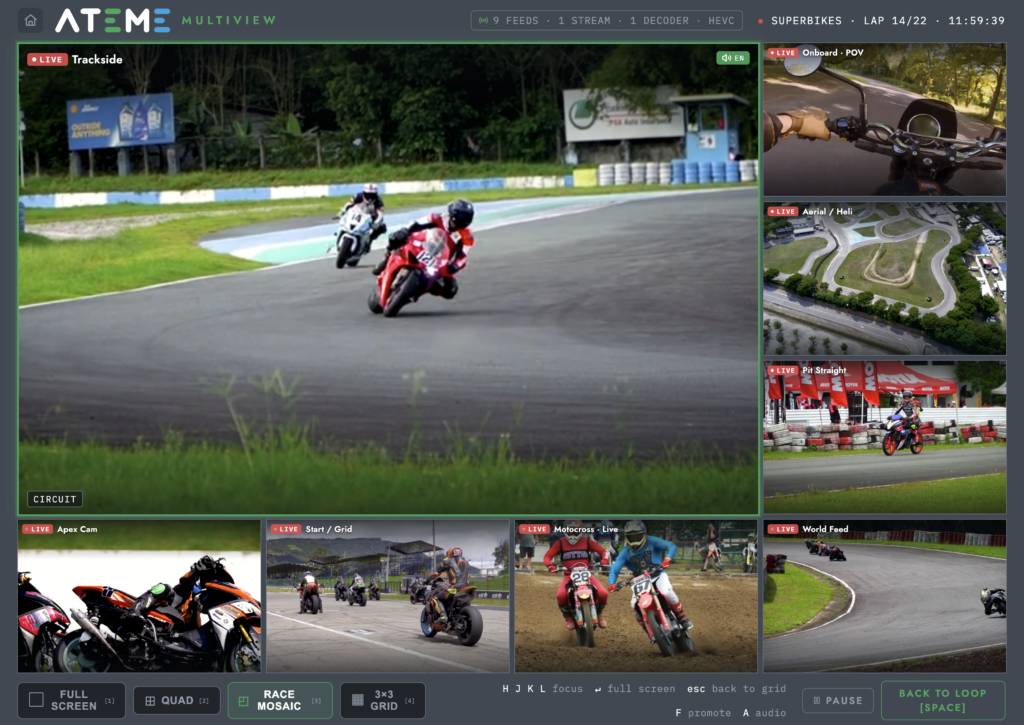
The demo on the stand ran three layouts. A quad puts four live matches on the screen at once, which is how many fans already follow a Saturday afternoon, with the other scores arriving on a phone. A mosaic keeps the main race feed as the large principal view and arranges the onboard, aerial and pit lane cameras around it, so the director’s cut still leads and the viewer adds the context. A three-by-three grid of live channels could replace the programme guide: switch on the set-top box and choose a channel by what is happening on it.
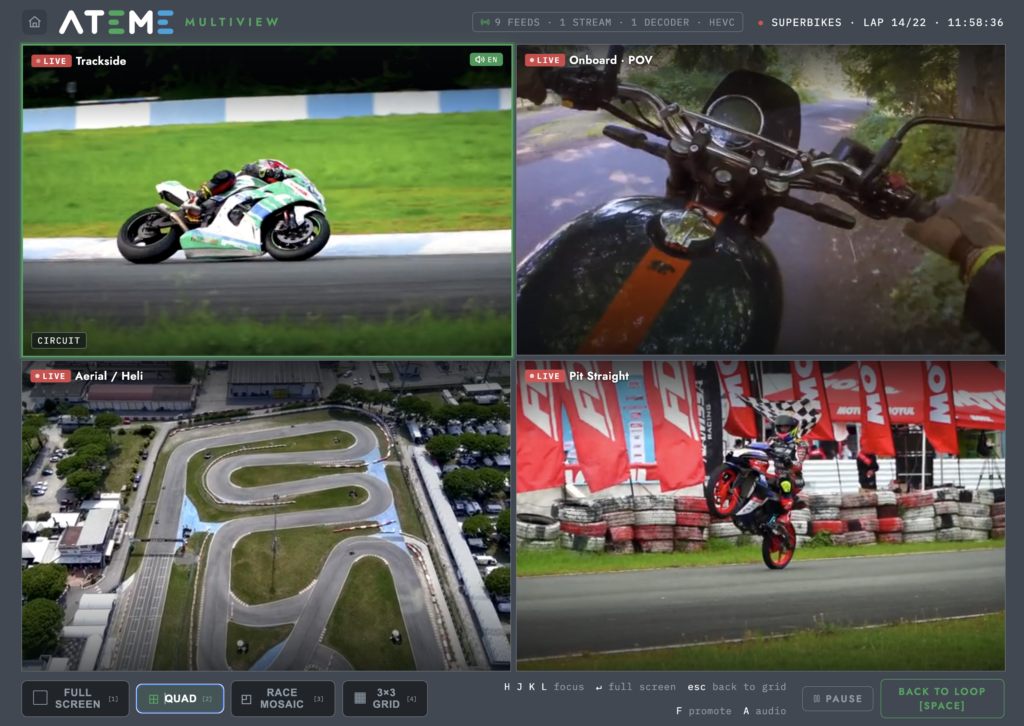
Every view carries its own audio. The main commentary plays by default, and the viewer can switch at any point; in the motorsport demo that means listening to the radio between a car and the pit wall while the race carries on across the rest of the screen. Any tile can then be taken full screen, where it plays at full quality, and one step brings the layout back. That round trip matters: nobody wants to find a settings menu at the moment a goal goes in.
Multiview starts at the encoder
It is tempting to think of multiview as a player feature, or as something a packager bolts onto streams that already exist. In practice every view on that screen is a live picture that has to hold up twice: as a tile occupying a fraction of the television, and again at full screen when the viewer selects it. How each feed is encoded decides how well it survives both, and how it is packaged decides whether a set-top box can play the result at all.
When encoding and packaging come from different suppliers, the space between them becomes the operator’s problem. Each side is tuned for its own job, the interop has to be proven on every device family, and when a picture looks soft in the corner of a mosaic, nobody owns the answer.
One chain, designed together
Ateme builds each part of that chain. TITAN Live encodes the feeds, NEA Genesis prepares and packages the views for delivery, and NEA CDN delivers them to the screen. Because the same Ateme engineering teams build and tune every stage, the settings that matter for multiview are decided together: how each feed is encoded for the way it will be displayed, how the views are assembled and signalled to the device, and how much delay each stage adds on the way through.
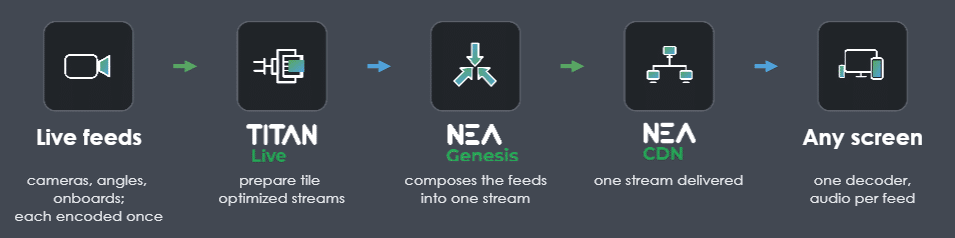
For an operator, that shows up in three places. Picture quality is set with both the tile and the full-screen view in mind. Latency is managed across the whole chain, which matters for live sport, where a viewer watching four matches will notice if one of them is behind. And interop between encoder, packager and device is Ateme’s responsibility, tested as one system before it reaches a subscriber.
Delivery is standards-based, and the Ateme Multiview Experience is being designed to work with AVC as well as HEVC, so it can reach the widest possible range of set-top boxes and smart TVs already in living rooms, where live sport is still watched as a shared event.
Operators design the experience
Ateme does not build the viewer interface. We provide the technology that delivers the views, and the operator decides how their audience sees them. A football league, a motorsport series and a round-the-clock news bundle each need a different arrangement, and the people who know which one suits their content are the operators who programme it. The layouts in the demo are examples; an operator can build a quad for the Saturday fixtures, a mosaic for race weekends and a grid for the channel line-up, all inside its own app and under its own brand.
The interest at IBC came from content owners with more pictures than one channel can carry, from network providers and pay-TV operators looking for reasons to keep subscribers on the big screen, and from OTT services competing for the same live rights, where the experience around those rights is one of the few things each of them controls.
Where a single picture still wins
Some moments belong to one picture. A cup final between two teams, with nothing else happening, is best served by one feed and one commentary team, and splitting the screen would take something away from it. Nine tiles on a television across a room is a lot to take in; a layout that works on a 65-inch set may be too busy on a smaller one. The director’s cut should stay the default, with multiview as the option viewers choose, and operators will need to design layouts with the same editorial care they give a broadcast.
The layout is what viewers notice first. Whether they keep watching depends on the quality of every tile on their screen, and that is settled at the encoder as much as the packager.
About the Author

CDN Product Manager & OTT Streaming Solutions Manager at Ateme
Mark brings 18+ years of experience in OTT streaming & Content Delivery Networks. With a background spanning product management, solution architecture, and business development, he helps content owners, telcos & network operators navigate modern streaming infrastructure, from CDN strategy and live video delivery to cloud-native OTT platform design.
At Ateme, Mark leads product direction for the NEA CDN portfolio and drives OTT & streaming solution strategy for major telcos and network operators worldwide, having previously spent 5 years as a Global Solution Architect. Prior to Ateme, he held solution architecture and business development roles at Velocix, part of Nokia/Alcatel-Lucent’s IP Video division.